

Volume 15, Issue 3 (10-2025)
J Health Saf Work. 2025, 15(3): 651-669 |
Back to browse issues page



Download citation:
BibTeX | RIS | EndNote | Medlars | ProCite | Reference Manager | RefWorks
Send citation to:


BibTeX | RIS | EndNote | Medlars | ProCite | Reference Manager | RefWorks
Send citation to:
Vahedparast H, Peykar S, Kamali F. The Relationship Between Work-Family Conflict Components and Psychological Distress in Female Nurses of Bushehr Province: A Path Analysis Study. J Health Saf Work. 2025; 15 (3) :651-669
URL: http://jhsw.tums.ac.ir/article-1-7211-en.html
URL: http://jhsw.tums.ac.ir/article-1-7211-en.html
1- Department of Medical-Surgical Nursing, Nursing and Midwifery Faculty of Bushehr University of Medical Sciences, Bushehr, Iran
2- Student Research Committee, Bushehr University of Medical Sciences, Bushehr, Iran
3- Department of Midwifery, Nursing and Midwifery Faculty of Bushehr University of Medical Sciences, Bushehr, Iran
2- Student Research Committee, Bushehr University of Medical Sciences, Bushehr, Iran
3- Department of Midwifery, Nursing and Midwifery Faculty of Bushehr University of Medical Sciences, Bushehr, Iran
Abstract: (2035 Views)
Introduction: Work-family conflict can lead to negative outcomes such as psychological distress in all employees, especially female nurses, as they face unique occupational challenges. However, the specific aspect of work-family conflict that contributes most significantly to psychological distress, as well as the underlying mechanisms involved, has not been thoroughly examined. The present study aimed to investigate the relationship between work-family conflict dimensions and psychological distress.
Material and Methods: This descriptive-analytical study was conducted in 2022 on 277 female nurses employed at public hospitals in Bushehr Province. The data collection tool consisted of work–family conflict and psychological distress questionnaires. The data were analyzed using SPSS v. 19 and PLS Graph v. 3, with path analysis.
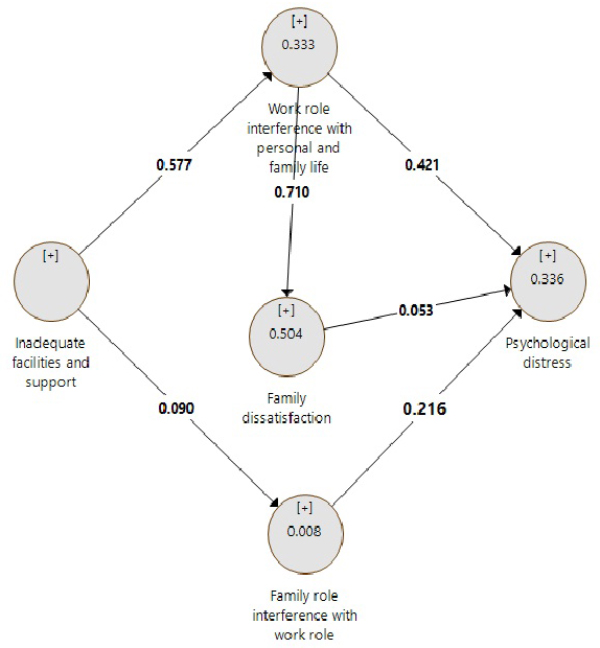
Results: The direct effects of two dimensions of work-family conflict, namely “the interference of work with personal and family life” and “the interference of family life with work,” on psychological distress were found to be statistically significant (p < 0.05). In addition, the mediating effect of the “work interference with personal and family life” on the relationship between “insufficient facilities and support” and psychological distress was statistically significant (p < 0.05). Meanwhile, the mediating effect of the “family dissatisfaction” in the relationship between “the interference of work with personal and family life” and psychological distress was not statistically significant (p > 0.05).
Conclusion: The interference of work with personal and family life, and the interference of family life with work, were identified as significant factors that directly affect psychological distress. In addition, “insufficient support and facilities” can increase “the interference of work with personal and family life”, thereby leading to greater psychological distress among female nurses. Planning to enhance support measures in both the workplace and personal life can help reduce the negative consequences of work-family conflict, such as psychological distress in female nurses.
Material and Methods: This descriptive-analytical study was conducted in 2022 on 277 female nurses employed at public hospitals in Bushehr Province. The data collection tool consisted of work–family conflict and psychological distress questionnaires. The data were analyzed using SPSS v. 19 and PLS Graph v. 3, with path analysis.
Results: The direct effects of two dimensions of work-family conflict, namely “the interference of work with personal and family life” and “the interference of family life with work,” on psychological distress were found to be statistically significant (p < 0.05). In addition, the mediating effect of the “work interference with personal and family life” on the relationship between “insufficient facilities and support” and psychological distress was statistically significant (p < 0.05). Meanwhile, the mediating effect of the “family dissatisfaction” in the relationship between “the interference of work with personal and family life” and psychological distress was not statistically significant (p > 0.05).
Conclusion: The interference of work with personal and family life, and the interference of family life with work, were identified as significant factors that directly affect psychological distress. In addition, “insufficient support and facilities” can increase “the interference of work with personal and family life”, thereby leading to greater psychological distress among female nurses. Planning to enhance support measures in both the workplace and personal life can help reduce the negative consequences of work-family conflict, such as psychological distress in female nurses.
| Rights and permissions | |
 |
This work is licensed under a Creative Commons Attribution-NonCommercial 4.0 International License. |
