

Volume 16, Issue 1 (3-2026)
J Health Saf Work. 2026, 16(1): 237-257 |
Back to browse issues page



Download citation:
BibTeX | RIS | EndNote | Medlars | ProCite | Reference Manager | RefWorks
Send citation to:


BibTeX | RIS | EndNote | Medlars | ProCite | Reference Manager | RefWorks
Send citation to:
Ahmadkhani F, Omari Shekaftik S, Kachuei R. Fungal Contaminants in Work Environments: A Threat to Occupational Health and Strategies for Their Management and Control. J Health Saf Work. 2026; 16 (1) :237-257
URL: http://jhsw.tums.ac.ir/article-1-7313-en.html
URL: http://jhsw.tums.ac.ir/article-1-7313-en.html
1- Student Research Committee, Baqiyatallah University of Medical Sciences, Tehran, Iran | Molecular Biology Research Center, Biomedicine Technologies Institute, Baqiyatallah University of Medical Sciences, Tehran, Iran
2- Department of Occupational Health Engineering, School of Public Health, Tehran University of Medical Sciences, Tehran, Iran | Students’ Scientific Research Center, Tehran University of Medical Sciences, Tehran, Iran
3- ,kachueir@gmail.com
2- Department of Occupational Health Engineering, School of Public Health, Tehran University of Medical Sciences, Tehran, Iran | Students’ Scientific Research Center, Tehran University of Medical Sciences, Tehran, Iran
3- ,
Abstract: (506 Views)
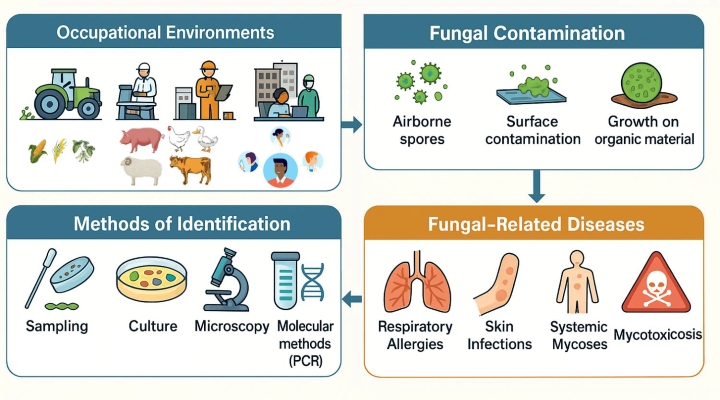
Introduction: Fungal contaminants in workplace environments pose significant biological hazards to employee health across various industries. This narrative review aims to explore the types of contaminating fungi, their health impacts, and strategies for prevention and control in occupational settings.
Material and Methods: This study was designed as a narrative review, with scientific literature sourced from databases including PubMed, Scopus, Web of Science, and local databases like Magiran and SID, covering the period from 2000 to March 2025. Keywords such as “fungal contaminants,” “occupational health,” and “mycotoxins” were used. Data were qualitatively analyzed and organized into thematic categories.
Results: Fungi such as Aspergillus, Penicillium, Cladosporium, and Stachybotrys are prevalent in environments with high humidity, poor ventilation, and abundant organic material, causing respiratory diseases, allergies, fungal infections, and chronic toxic effects. Identification methods include air sampling, molecular analysis, and mycotoxin assessment. Effective control measures encompass humidity management, enhanced ventilation, and personal protective equipment.
Conclusion: Effective management of fungal contaminants requires integrated approaches, including accurate identification, environmental control, and employee training. These measures can enhance worker health and reduce economic and social costs.
Material and Methods: This study was designed as a narrative review, with scientific literature sourced from databases including PubMed, Scopus, Web of Science, and local databases like Magiran and SID, covering the period from 2000 to March 2025. Keywords such as “fungal contaminants,” “occupational health,” and “mycotoxins” were used. Data were qualitatively analyzed and organized into thematic categories.
Results: Fungi such as Aspergillus, Penicillium, Cladosporium, and Stachybotrys are prevalent in environments with high humidity, poor ventilation, and abundant organic material, causing respiratory diseases, allergies, fungal infections, and chronic toxic effects. Identification methods include air sampling, molecular analysis, and mycotoxin assessment. Effective control measures encompass humidity management, enhanced ventilation, and personal protective equipment.
Conclusion: Effective management of fungal contaminants requires integrated approaches, including accurate identification, environmental control, and employee training. These measures can enhance worker health and reduce economic and social costs.
Type of Study: Review |
Send email to the article author
| Rights and permissions | |
 |
This work is licensed under a Creative Commons Attribution-NonCommercial 4.0 International License. |
