

Volume 16, Issue 1 (3-2026)
J Health Saf Work. 2026, 16(1): 213-236 |
Back to browse issues page



Download citation:
BibTeX | RIS | EndNote | Medlars | ProCite | Reference Manager | RefWorks
Send citation to:


BibTeX | RIS | EndNote | Medlars | ProCite | Reference Manager | RefWorks
Send citation to:
Paridokht F, Tabrizi A, Mohsenian A, Khorshidi Behzadi Y, Salehi Sahlabadi A. Investigation of Occupational Stress, Job Burnout, and Musculoskeletal Discomfort Among Dentists and the Role of Ergonomics in Reducing Them: A Systematic Review. J Health Saf Work. 2026; 16 (1) :213-236
URL: http://jhsw.tums.ac.ir/article-1-7312-en.html
URL: http://jhsw.tums.ac.ir/article-1-7312-en.html
Fatemeh Paridokht1, Akram Tabrizi2, Ali Mohsenian3, Yaser Khorshidi Behzadi2, Ali Salehi Sahlabadi *4
1- Safety Promotion and Injury Prevention Research Center, Research Institute for Health Sciences and Environment, Shahid Beheshti University of Medical Sciences, Tehran, Iran | Department of Occupational Health and Safety Engineering, School of Public Health and Safety, Shahid Beheshti University of Medical Sciences, Tehran, Iran
2- Department of Occupational Health and Safety Engineering, School of Public Health and Safety, Shahid Beheshti University of Medical Sciences, Tehran, Iran
3- Student Research Committee, Shiraz University of Medical Sciences, Shiraz, Iran
4- Safety Promotion and Injury Prevention Research Center, Research Institute for Health Sciences and Environment, Shahid Beheshti University of Medical Sciences, Tehran, Iran | Department of Occupational Health and Safety Engineering, School of Public Health and Safety, Shahid Beheshti University of Medical Sciences, Tehran, Iran ,asalehi529@gmail.com
2- Department of Occupational Health and Safety Engineering, School of Public Health and Safety, Shahid Beheshti University of Medical Sciences, Tehran, Iran
3- Student Research Committee, Shiraz University of Medical Sciences, Shiraz, Iran
4- Safety Promotion and Injury Prevention Research Center, Research Institute for Health Sciences and Environment, Shahid Beheshti University of Medical Sciences, Tehran, Iran | Department of Occupational Health and Safety Engineering, School of Public Health and Safety, Shahid Beheshti University of Medical Sciences, Tehran, Iran ,
Abstract: (617 Views)
Introduction: Dentistry is considered a highly stressful profession due to its nature, placing dentists at an increased risk of occupational burnout and musculoskeletal disorders. This study aimed to investigate stress, occupational burnout, and musculoskeletal discomfort among dentists, as well as the role of ergonomics in reducing these problems.
Material and Methods: This study is a systematic review of articles published from 2000 to March 2025 in three databases: Scopus, Web of Science, and PubMed. The inclusion criteria required original research in English—experimental, observational, or conference-based—addressing both the prevalence of occupational stress, burnout, and/or WMSD in dentists and the impact of ergonomic interventions. Unrelated articles, review papers, books, letters to the editor, and book chapters were excluded.
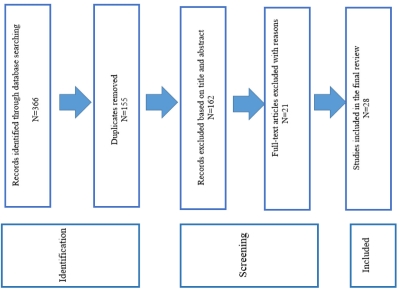
Results: Out of 366 identified articles, 28 met the inclusion criteria. The most frequently reported discomforts were in the neck, lower back, shoulders, wrists, upper back, forearms, and arms, respectively. Dentists with a higher risk of occupational burnout reported more health complaints, and patient care was identified as the main source of stress. Moreover, the use of ergonomic aids—such as dental magnification loupes, optimized hand tool designs, and prismatic glasses—played a significant role in reducing musculoskeletal discomfort among dentists.
Conclusion: Stress, burnout, and musculoskeletal disorders are common challenges in the dental profession. Strong evidence supports the effectiveness of ergonomic interventions in reducing the physical burden of these problems; however, implementation faces barriers such as high costs and insufficient training. Therefore, it is recommended that ergonomic principles and the use of assistive tools be integrated as essential components of dental education curricula and ongoing professional development programs.
Material and Methods: This study is a systematic review of articles published from 2000 to March 2025 in three databases: Scopus, Web of Science, and PubMed. The inclusion criteria required original research in English—experimental, observational, or conference-based—addressing both the prevalence of occupational stress, burnout, and/or WMSD in dentists and the impact of ergonomic interventions. Unrelated articles, review papers, books, letters to the editor, and book chapters were excluded.
Results: Out of 366 identified articles, 28 met the inclusion criteria. The most frequently reported discomforts were in the neck, lower back, shoulders, wrists, upper back, forearms, and arms, respectively. Dentists with a higher risk of occupational burnout reported more health complaints, and patient care was identified as the main source of stress. Moreover, the use of ergonomic aids—such as dental magnification loupes, optimized hand tool designs, and prismatic glasses—played a significant role in reducing musculoskeletal discomfort among dentists.
Conclusion: Stress, burnout, and musculoskeletal disorders are common challenges in the dental profession. Strong evidence supports the effectiveness of ergonomic interventions in reducing the physical burden of these problems; however, implementation faces barriers such as high costs and insufficient training. Therefore, it is recommended that ergonomic principles and the use of assistive tools be integrated as essential components of dental education curricula and ongoing professional development programs.
Keywords: Occupational stress, Job burnout, Musculoskeletal discomfort, Dentists, Prismatic spectacles, Dental loupes
Type of Study: Review |
Send email to the article author
| Rights and permissions | |
 |
This work is licensed under a Creative Commons Attribution-NonCommercial 4.0 International License. |
