

Volume 15, Issue 4 (12-2025)
J Health Saf Work. 2025, 15(4): 842-863 |
Back to browse issues page



Download citation:
BibTeX | RIS | EndNote | Medlars | ProCite | Reference Manager | RefWorks
Send citation to:


BibTeX | RIS | EndNote | Medlars | ProCite | Reference Manager | RefWorks
Send citation to:
Dargahi-Gharehbagh O, Jabbari M, Monazami Tehrani G. Fire Growth and Smoke Transport Modeling Based on Risk Assessment in a High-Rise Hospital in Tehran. J Health Saf Work. 2025; 15 (4) :842-863
URL: http://jhsw.tums.ac.ir/article-1-7259-en.html
URL: http://jhsw.tums.ac.ir/article-1-7259-en.html
1- School of Public Health and Safety, Shahid Beheshti University of Medical Sciences, Tehran, Iran
2- Workplace Health Promotion Research Center, Shahid Beheshti University of Medical Sciences, Tehran, Iran | Department of Occupational Health and Safety Engineering, School of Public Health and Safety, Shahid Beheshti University of Medical Sciences, Tehran, Iran
3- Department of Health, Safety and Environment, School of Public Health and Safety, Shahid Beheshti University of Medical Sciences, Tehran, Iran
2- Workplace Health Promotion Research Center, Shahid Beheshti University of Medical Sciences, Tehran, Iran | Department of Occupational Health and Safety Engineering, School of Public Health and Safety, Shahid Beheshti University of Medical Sciences, Tehran, Iran
3- Department of Health, Safety and Environment, School of Public Health and Safety, Shahid Beheshti University of Medical Sciences, Tehran, Iran
Abstract: (1143 Views)
Introduction: Hospitals represent a critical fire safety challenge. The presence of patients with limited mobility, specialized staff, and invaluable infrastructure makes them seriously vulnerable. Further, toxic smoke inhalation, as a primary product of fire, is a leading cause of mortality. To address this concern, our study intended to conduct a comprehensive fire safety assessment of a teaching hospital in Tehran (2023-2024) by integrating risk assessment with numerical modeling.
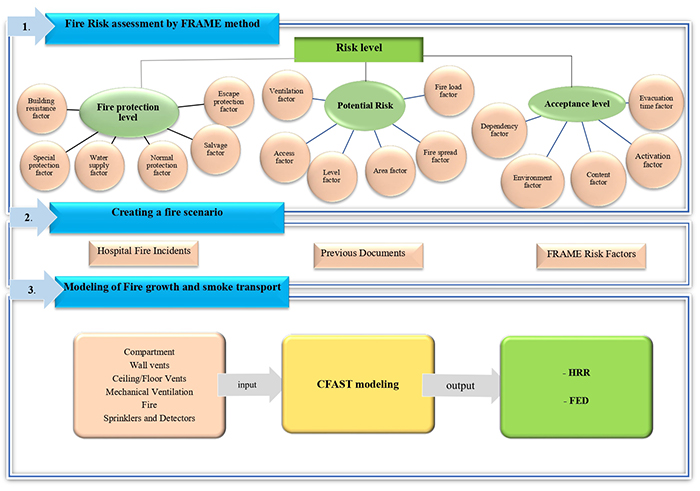
Material and Methods: This study was conducted in a teaching hospital following three consecutive steps: risk assessment, fire scenario design, and fire and smoke modeling. First, vulnerable zones were identified using the FRAME method. Next, fire scenarios and control strategies were designed based on the identified risk factors and a review of the relevant literature. Ultimately, fire and smoke transport was modeled using the CFAST software to ascertain the performance of the proposed strategies.
Results: The risk assessment pinpointed two wards with unacceptably high occupant risk levels: the inpatient ward on the 10th floor, owing to a cluster of unsafe behaviors, and the basement warehouse, owing to improper storage and inadequate emergency exit access. Fire and smoke modeling was performed for these two zones, comparing the “current situation” against a proposed “risk control strategy.” The modeling results revealed that the control strategy positively affected key life safety indicators, significantly ameliorating the Fractional Effective Dose (FED) and Heat Release Rate (HRR).
Conclusion: According to this study, a fire risk assessment provides a clear and detailed perspective on a hospital building’s fire safety. Integrating the results of the FRAME assessment with CFAST simulations results in a comprehensive understanding of the facility’s safety status. These data can be utilized to design effective emergency plans and calculate the Required Safe Egress Time (RSET), thereby preventing life-threatening harm to occupants against toxic gases.
Material and Methods: This study was conducted in a teaching hospital following three consecutive steps: risk assessment, fire scenario design, and fire and smoke modeling. First, vulnerable zones were identified using the FRAME method. Next, fire scenarios and control strategies were designed based on the identified risk factors and a review of the relevant literature. Ultimately, fire and smoke transport was modeled using the CFAST software to ascertain the performance of the proposed strategies.
Results: The risk assessment pinpointed two wards with unacceptably high occupant risk levels: the inpatient ward on the 10th floor, owing to a cluster of unsafe behaviors, and the basement warehouse, owing to improper storage and inadequate emergency exit access. Fire and smoke modeling was performed for these two zones, comparing the “current situation” against a proposed “risk control strategy.” The modeling results revealed that the control strategy positively affected key life safety indicators, significantly ameliorating the Fractional Effective Dose (FED) and Heat Release Rate (HRR).
Conclusion: According to this study, a fire risk assessment provides a clear and detailed perspective on a hospital building’s fire safety. Integrating the results of the FRAME assessment with CFAST simulations results in a comprehensive understanding of the facility’s safety status. These data can be utilized to design effective emergency plans and calculate the Required Safe Egress Time (RSET), thereby preventing life-threatening harm to occupants against toxic gases.
Type of Study: Research |
| Rights and permissions | |
 |
This work is licensed under a Creative Commons Attribution-NonCommercial 4.0 International License. |
