

Volume 15, Issue 3 (10-2025)
J Health Saf Work. 2025, 15(3): 724-746 |
Back to browse issues page


Download citation:
BibTeX | RIS | EndNote | Medlars | ProCite | Reference Manager | RefWorks
Send citation to:


BibTeX | RIS | EndNote | Medlars | ProCite | Reference Manager | RefWorks
Send citation to:
Esmali R, Akhlaghi Pirposhteh E, Askari A, Poursadeghiyan M. An Overview of the Applications and Conditions for Using Artificial Intelligence and Digitalization in Occupational Health and Safety in the Workplace. J Health Saf Work. 2025; 15 (3) :724-746
URL: http://jhsw.tums.ac.ir/article-1-7214-en.html
URL: http://jhsw.tums.ac.ir/article-1-7214-en.html
1- Students Research Committee, Faculty of Health, Ardabil University of Medical Sciences, Ardabil, Iran
2- Department of Occupational Health and Safety Engineering, Faculty of Medical Sciences, Tarbiat Modares University, Tehran, Iran
3- Department of Occupational Health, School of Public Health, Tehran University of Medical Sciences, Tehran, Iran | Department of Occupational Health and Safety, OICO, AZAR Oilfield Project, Ilam, Iran ,a-askari@razi.tums.ac.ir
4- Social Determinants of Health Research Center, Ardabil University of Medical Sciences, Ardabil, Iran | Department of Occupational Health Engineering, School of Health, Ardabil University of Medical Sciences, Ardabil, Iran
2- Department of Occupational Health and Safety Engineering, Faculty of Medical Sciences, Tarbiat Modares University, Tehran, Iran
3- Department of Occupational Health, School of Public Health, Tehran University of Medical Sciences, Tehran, Iran | Department of Occupational Health and Safety, OICO, AZAR Oilfield Project, Ilam, Iran ,
4- Social Determinants of Health Research Center, Ardabil University of Medical Sciences, Ardabil, Iran | Department of Occupational Health Engineering, School of Health, Ardabil University of Medical Sciences, Ardabil, Iran
Abstract: (3272 Views)
Introduction: Artificial Intelligence (AI) and digitalization are pivotal in enhancing Occupational Health and Safety (OHS), reducing workplace accidents, improving conditions, and boosting organizational productivity. This study examines the impacts, challenges, and opportunities of these technologies in workplace safety.
Material and Methods: A narrative review was conducted via databases (Google Scholar, PubMed, IEEE Xplore, ScienceDirect) using keywords like “AI in occupational safety” (2013–January 2025). After screening 125 articles, 71 met the inclusion criteria (Persian or English publications). Qualitative content analysis identified key challenges and opportunities.
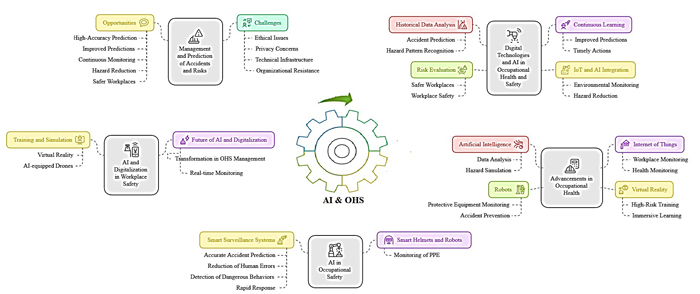
Results: Artificial intelligence has been used in predicting incidents, monitoring, process optimization, and analyzing OHS challenges. By analyzing historical data and hazard patterns, AI enables proactive risk mitigation. Continuous learning in AI models enhances predictive accuracy and environmental adaptability. However, data quality issues persist; techniques such as transfer learning offer potential solutions. AI-driven automation reduces human error, yet challenges include ethical concerns and infrastructure gaps.
Conclusion: AI and digital technologies are transforming OHS through predictive analytics and real-time surveillance. To fully leverage these benefits, future efforts must focus on addressing data quality issues, establishing robust ethical frameworks, and developing advanced infrastructure. Further research is essential for the practical implementation of AI in a variety of work environments.
Material and Methods: A narrative review was conducted via databases (Google Scholar, PubMed, IEEE Xplore, ScienceDirect) using keywords like “AI in occupational safety” (2013–January 2025). After screening 125 articles, 71 met the inclusion criteria (Persian or English publications). Qualitative content analysis identified key challenges and opportunities.
Results: Artificial intelligence has been used in predicting incidents, monitoring, process optimization, and analyzing OHS challenges. By analyzing historical data and hazard patterns, AI enables proactive risk mitigation. Continuous learning in AI models enhances predictive accuracy and environmental adaptability. However, data quality issues persist; techniques such as transfer learning offer potential solutions. AI-driven automation reduces human error, yet challenges include ethical concerns and infrastructure gaps.
Conclusion: AI and digital technologies are transforming OHS through predictive analytics and real-time surveillance. To fully leverage these benefits, future efforts must focus on addressing data quality issues, establishing robust ethical frameworks, and developing advanced infrastructure. Further research is essential for the practical implementation of AI in a variety of work environments.
Keywords: Artificial intelligence, Digitalization, Occupational health, Workplace safety, Internet of things, Virtual reality
Send email to the article author
| Rights and permissions | |
 |
This work is licensed under a Creative Commons Attribution-NonCommercial 4.0 International License. |
