

Volume 15, Issue 3 (10-2025)
J Health Saf Work. 2025, 15(3): 589-611 |
Back to browse issues page


Download citation:
BibTeX | RIS | EndNote | Medlars | ProCite | Reference Manager | RefWorks
Send citation to:


BibTeX | RIS | EndNote | Medlars | ProCite | Reference Manager | RefWorks
Send citation to:
Najafi A, Golbabaei F, Sadeghi Yarandi M, Yaseri M, Jahani R, Shams S R et al . Comparative Quantitative and Semi-Quantitative Occupational Risk Assessment of BTEX Compounds and Heavy Metals in a Power Equipment Manufacturing Industry. J Health Saf Work. 2025; 15 (3) :589-611
URL: http://jhsw.tums.ac.ir/article-1-7208-en.html
URL: http://jhsw.tums.ac.ir/article-1-7208-en.html
Azin Najafi1, Farideh Golbabaei1, Mohsen Sadeghi Yarandi1, Mehdi Yaseri2, Reza Jahani3, Seyedeh Reyhaneh Shams4, Saba Kalantary *5
1- Department of Occupational Health Engineering, School of Public Health, Tehran University of Medical Sciences, Tehran, Iran
2- Department of Epidemiology and Biostatistics, School of Public Health, Tehran University of Medical Sciences, Tehran, Iran
3- Department of Toxicology and Pharmacology, School of Pharmacy, Shahid Beheshti University of Medical Sciences, Tehran, Iran
4- Department of Earth and Atmospheric Sciences, University of Houston, TX, 77004, USA
5- Department of Occupational Health Engineering, School of Public Health, Tehran University of Medical Sciences, Tehran, Iran ,s-kalantari@sina.tuma.sc.ir
2- Department of Epidemiology and Biostatistics, School of Public Health, Tehran University of Medical Sciences, Tehran, Iran
3- Department of Toxicology and Pharmacology, School of Pharmacy, Shahid Beheshti University of Medical Sciences, Tehran, Iran
4- Department of Earth and Atmospheric Sciences, University of Houston, TX, 77004, USA
5- Department of Occupational Health Engineering, School of Public Health, Tehran University of Medical Sciences, Tehran, Iran ,
Abstract: (2117 Views)
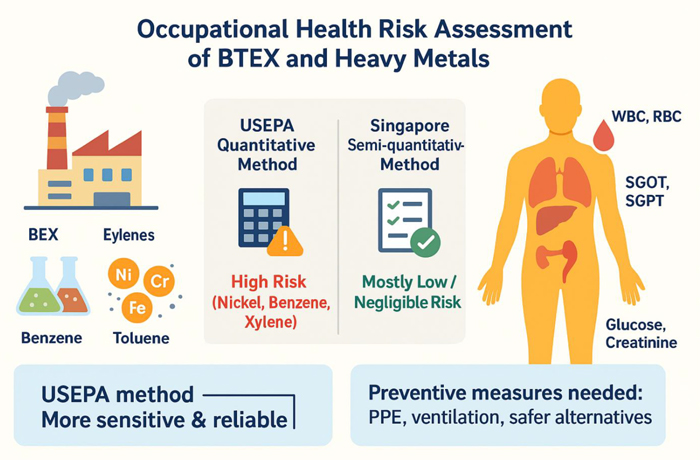
Introduction: Occupational exposure to volatile organic compounds (BTEX) and heavy metals in industrial settings poses significant health concerns. These substances may lead to toxic, carcinogenic, and hematobiochemical effects. This study aimed to assess the health risks associated with exposure to these pollutants in a power equipment manufacturing industry over a 10-year period and to compare the accuracy of quantitative (USEPA) and semi-quantitative (Singapore) risk assessment methods.
Material and Methods: This cross-sectional study was conducted across six occupational groups. Personal air sampling of BTEX and heavy metals was performed according to NIOSH protocols. Carcinogenic and non-carcinogenic risks were estimated using the USEPA method and the Singapore semi-quantitative approach. Additionally, hematological and biochemical indicators of exposed workers were analyzed.
Results: Nickel had the highest cancer risk, and the highest hazard quotient (HQ) values were related to xylene, benzene, and nickel. While the semi-quantitative method classified most risks as negligible to low, the USEPA method identified several cases with definite health risks. Significant effects were observed on SGOT, SGPT, fasting blood sugar, creatinine, and blood pressure among exposed groups.
Conclusion: The USEPA method demonstrated higher sensitivity and reliability in identifying occupational chemical hazards and should be prioritized in future assessments. Furthermore, the findings underscore the importance of preventive measures to reduce chronic exposure to BTEX and heavy metals in similar industrial settings.
Material and Methods: This cross-sectional study was conducted across six occupational groups. Personal air sampling of BTEX and heavy metals was performed according to NIOSH protocols. Carcinogenic and non-carcinogenic risks were estimated using the USEPA method and the Singapore semi-quantitative approach. Additionally, hematological and biochemical indicators of exposed workers were analyzed.
Results: Nickel had the highest cancer risk, and the highest hazard quotient (HQ) values were related to xylene, benzene, and nickel. While the semi-quantitative method classified most risks as negligible to low, the USEPA method identified several cases with definite health risks. Significant effects were observed on SGOT, SGPT, fasting blood sugar, creatinine, and blood pressure among exposed groups.
Conclusion: The USEPA method demonstrated higher sensitivity and reliability in identifying occupational chemical hazards and should be prioritized in future assessments. Furthermore, the findings underscore the importance of preventive measures to reduce chronic exposure to BTEX and heavy metals in similar industrial settings.
Keywords: Risk assessment, US environmental protection agency method, Singapore semi-quantitative method, BTEX, Metals
Send email to the article author
| Rights and permissions | |
 |
This work is licensed under a Creative Commons Attribution-NonCommercial 4.0 International License. |
