

Volume 15, Issue 3 (10-2025)
J Health Saf Work. 2025, 15(3): 558-573 |
Back to browse issues page



Download citation:
BibTeX | RIS | EndNote | Medlars | ProCite | Reference Manager | RefWorks
Send citation to:


BibTeX | RIS | EndNote | Medlars | ProCite | Reference Manager | RefWorks
Send citation to:
Fallah Madvari R, Bidel H, Ghajari H, Jegari Z, Babaee F, Abbasi M. Studying the Effect of Noise Annoyance on the Anxiety of Workers in a Corrugated Packaging Manufacturing Company: A Case Study. J Health Saf Work. 2025; 15 (3) :558-573
URL: http://jhsw.tums.ac.ir/article-1-7206-en.html
URL: http://jhsw.tums.ac.ir/article-1-7206-en.html
Rohollah Fallah Madvari1, Hamideh Bidel *2, Hadis Ghajari3, Zahra Jegari4, Fatema Babaee5, Milad Abbasi6
1- Occupational Health Research Center, Department of Occupational Health Engineering, School of Public Health, Shahid Sadoughi University of Medical Sciences, Yazd, Iran
2- Department of Occupational Health Engineering, Faculty of Health, Social Determinants of Health Research Center, Gonabad University of Medical Sciences, Gonabad, Iran ,hamidebidel@gmail.com
3- Department of Epidemiology, School of Public Health and Safety, Shahid Beheshti University of Medical Sciences, Tehran, Iran
4- Department of Occupational Health and Safety, School of Public Health and Safety, Shahid Beheshti University of Medical Sciences, Tehran, Iran
5- Department of Psychology, Payame Noor University, Yazd, Iran
6- Social Determinants of Health Research Center, Saveh University of Medical Sciences, Saveh, Iran
2- Department of Occupational Health Engineering, Faculty of Health, Social Determinants of Health Research Center, Gonabad University of Medical Sciences, Gonabad, Iran ,
3- Department of Epidemiology, School of Public Health and Safety, Shahid Beheshti University of Medical Sciences, Tehran, Iran
4- Department of Occupational Health and Safety, School of Public Health and Safety, Shahid Beheshti University of Medical Sciences, Tehran, Iran
5- Department of Psychology, Payame Noor University, Yazd, Iran
6- Social Determinants of Health Research Center, Saveh University of Medical Sciences, Saveh, Iran
Abstract: (1923 Views)
Introduction: Workplace noise is one of the main sources of health problems. Noise can have many direct and indirect effects that threaten human health in various ways. The aim of this study was to investigate the effect of noise annoyance on anxiety among workers.
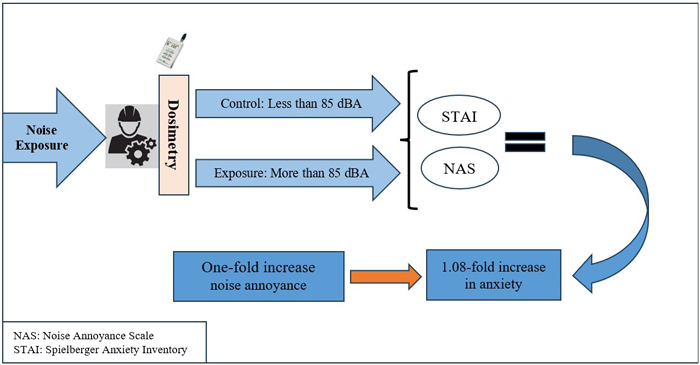
Material and Methods: This study included 60 workers from a carton manufacturing company, who were divided into two groups based on noise exposure: exposure (noise level more than 85 dB) and control (noise level less than 85 dB). Noise exposure of the individuals at the workplace was measured in accordance with ISO 9612:2009 standard and using a TES-1354 dosimeter. Anxiety levels were assessed using the Spielberger Anxiety Inventory (STAI), and noise annoyance was measured using a 100-point visual analog scale. Statistical analysis was performed using STATA statistical software.
Results: The mean age and work experience of the study subjects were 35.78 and 10.78 years, respectively. The results indicated a statistically significant difference (P-value < 0.05) in the mean noise annoyance scores between the groups. The mean noise annoyance score in the exposed group was significantly higher (88.03) than in the non-exposed group (47.6). The average anxiety scores in the exposure and control groups were 106.81 and 101.6, respectively. In addition, regression analysis showed that each unit increase in noise annoyance level resulted in a 1.08-fold increase in anxiety in the exposed group.
Conclusion: Noise annoyance is often the most common psychological response to noise exposure and can be a predictor of many mental disorders or illnesses, including anxiety. Therefore, it is important to implement control measures to reduce noise exposure in the workplace.
Material and Methods: This study included 60 workers from a carton manufacturing company, who were divided into two groups based on noise exposure: exposure (noise level more than 85 dB) and control (noise level less than 85 dB). Noise exposure of the individuals at the workplace was measured in accordance with ISO 9612:2009 standard and using a TES-1354 dosimeter. Anxiety levels were assessed using the Spielberger Anxiety Inventory (STAI), and noise annoyance was measured using a 100-point visual analog scale. Statistical analysis was performed using STATA statistical software.
Results: The mean age and work experience of the study subjects were 35.78 and 10.78 years, respectively. The results indicated a statistically significant difference (P-value < 0.05) in the mean noise annoyance scores between the groups. The mean noise annoyance score in the exposed group was significantly higher (88.03) than in the non-exposed group (47.6). The average anxiety scores in the exposure and control groups were 106.81 and 101.6, respectively. In addition, regression analysis showed that each unit increase in noise annoyance level resulted in a 1.08-fold increase in anxiety in the exposed group.
Conclusion: Noise annoyance is often the most common psychological response to noise exposure and can be a predictor of many mental disorders or illnesses, including anxiety. Therefore, it is important to implement control measures to reduce noise exposure in the workplace.
Keywords: Noise annoyance, Anxiety, Noise exposure, Dosimetry, ISO 9612:2009, Carton manufacturing company
Send email to the article author
| Rights and permissions | |
 |
This work is licensed under a Creative Commons Attribution-NonCommercial 4.0 International License. |
