

Volume 16, Issue 1 (3-2026)
J Health Saf Work 2026, 16(1): 146-167 |
Back to browse issues page



Download citation:
BibTeX | RIS | EndNote | Medlars | ProCite | Reference Manager | RefWorks
Send citation to:


BibTeX | RIS | EndNote | Medlars | ProCite | Reference Manager | RefWorks
Send citation to:
Ghasemi N, Sadeghi-Yarandi M, Yaghoub Nejad N, Ghasemi M, Zare R, Najafi Pour A M. Evaluating the Impact of Respiratory Exposure to Hospital Chemicals on Lung Function and Blood Markers in Employees of a Healthcare Facility. J Health Saf Work 2026; 16 (1) :146-167
URL: http://jhsw.tums.ac.ir/article-1-7309-en.html
URL: http://jhsw.tums.ac.ir/article-1-7309-en.html
Neda Ghasemi1 
 , Mohsen Sadeghi-Yarandi2 , Neda Yaghoub Nejad3 , Morteza Ghasemi4 , Ramin Zare5 , Amir Mohammad Najafi Pour *6
, Mohsen Sadeghi-Yarandi2 , Neda Yaghoub Nejad3 , Morteza Ghasemi4 , Ramin Zare5 , Amir Mohammad Najafi Pour *6
1- Department of Ergonomics, School of Public Health and Safety, Shahid Beheshti University of Medical Sciences, Tehran, Iran
2- Health in Emergency and Disasters Research Center, University of Social Welfare and Rehabilitation Sciences, Tehran, Iran
3- Department of Management, Faculty of Management, Iran University of Medical Sciences, Tehran, Iran
4- Department of Health Services Management, School of Health, Islamic Azad University, South Tehran Branch, Tehran, Iran
5- Heath Department, Faculty of Medical Sciences, Islamic Azad University, Arak Branch, Arak, Iran
6- amirmohamadnajafipour@gmail.com
2- Health in Emergency and Disasters Research Center, University of Social Welfare and Rehabilitation Sciences, Tehran, Iran
3- Department of Management, Faculty of Management, Iran University of Medical Sciences, Tehran, Iran
4- Department of Health Services Management, School of Health, Islamic Azad University, South Tehran Branch, Tehran, Iran
5- Heath Department, Faculty of Medical Sciences, Islamic Azad University, Arak Branch, Arak, Iran
6- amirmohamadnajafipour@gmail.com
Abstract: (98 Views)
Introduction: Employees in various departments of hospital are inevitably exposed to toxic gases, including isoflurane, as well as BTEX, formaldehyde, nitric acid, and chlorine. Therefore, this study aims to evaluate the impact of chemical exposure on pulmonary and hematological parameters among hospital staff.
Material and Methods: The present cross-sectional study was conducted in 2024 at a hospital in Tehran, involving a sample size of 240 participants. Standard methods established by OSHA and NIOSH were employed for sampling, transfer, and laboratory analysis. A history of respiratory symptoms was obtained using the American Thoracic Society Questionnaire (ATSQ). Additionally, lung function was assessed through spirometry tests, and blood samples were collected to analyze the participants’ hematological factors.
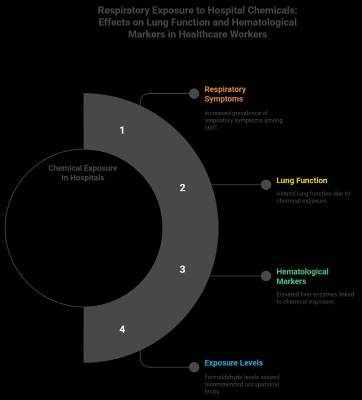
Results: The exposure levels of benzene (0.3 ppm), ethylbenzene (12 ppm), toluene (9 ppm), xylene (50 ppm), nitric acid (0.9 ppm), isoflurane (1.6 ppm), and chlorine (0.06 ppm) were found to be below the maximum occupational exposure limits. The average occupational exposure of staff in the operating room and pathology laboratory over an 8-hour period was 0.16 ppm for formaldehyde, which exceeds the ACGIH-recommended acceptable occupational exposure limits (OEL). Findings revealed a correlation between the prevalence of respiratory symptoms and elevated liver enzymes in employees exposed to formaldehyde and isoflurane.
Conclusion: The results indicated a significantly higher prevalence of respiratory symptoms and liver enzyme disorders in individuals exposed to isoflurane and formaldehyde compared to the control group. Furthermore, significant differences were observed in pulmonary function tests and liver enzyme levels in the blood of subjects exposed to these substances, in contrast to the control group. It is recommended that individuals working in operating rooms and pathology laboratories implement engineering controls and management practices related to occupational health and safety, and utilize appropriate personal protective equipment, particularly due to exposure to isoflurane and formaldehyde gases.
Material and Methods: The present cross-sectional study was conducted in 2024 at a hospital in Tehran, involving a sample size of 240 participants. Standard methods established by OSHA and NIOSH were employed for sampling, transfer, and laboratory analysis. A history of respiratory symptoms was obtained using the American Thoracic Society Questionnaire (ATSQ). Additionally, lung function was assessed through spirometry tests, and blood samples were collected to analyze the participants’ hematological factors.
Results: The exposure levels of benzene (0.3 ppm), ethylbenzene (12 ppm), toluene (9 ppm), xylene (50 ppm), nitric acid (0.9 ppm), isoflurane (1.6 ppm), and chlorine (0.06 ppm) were found to be below the maximum occupational exposure limits. The average occupational exposure of staff in the operating room and pathology laboratory over an 8-hour period was 0.16 ppm for formaldehyde, which exceeds the ACGIH-recommended acceptable occupational exposure limits (OEL). Findings revealed a correlation between the prevalence of respiratory symptoms and elevated liver enzymes in employees exposed to formaldehyde and isoflurane.
Conclusion: The results indicated a significantly higher prevalence of respiratory symptoms and liver enzyme disorders in individuals exposed to isoflurane and formaldehyde compared to the control group. Furthermore, significant differences were observed in pulmonary function tests and liver enzyme levels in the blood of subjects exposed to these substances, in contrast to the control group. It is recommended that individuals working in operating rooms and pathology laboratories implement engineering controls and management practices related to occupational health and safety, and utilize appropriate personal protective equipment, particularly due to exposure to isoflurane and formaldehyde gases.
Keywords: Chemical compounds, Occupational exposure, Hospital employees, Pulmonary parameters, Blood parameters
Type of Study: Review |
| Rights and permissions | |
 |
This work is licensed under a Creative Commons Attribution-NonCommercial 4.0 International License. |
