

Volume 16, Issue 1 (3-2026)
J Health Saf Work 2026, 16(1): 99-118 |
Back to browse issues page



Download citation:
BibTeX | RIS | EndNote | Medlars | ProCite | Reference Manager | RefWorks
Send citation to:


BibTeX | RIS | EndNote | Medlars | ProCite | Reference Manager | RefWorks
Send citation to:
Baghdadi F, Zendehdel R, Panjali Z, Hajighasemkhan A. Prediction of Mineral Oil Concentrations Using Fourier Transform Infrared (FTIR) and Modeling Methods. J Health Saf Work 2026; 16 (1) :99-118
URL: http://jhsw.tums.ac.ir/article-1-7307-en.html
URL: http://jhsw.tums.ac.ir/article-1-7307-en.html


1- Department of Occupational Health and Safety Engineering, Faculty of Health and Safety, Shahid Beheshti University of Medical Sciences, Tehran, Iran
2- Department of Occupational Health and Safety Engineering, Faculty of Health, Islamic Azad University of Medical Sciences, Tehran, Iran
3- Department of Occupational Health and Safety Engineering, Faculty of Health and Safety, Shahid Beheshti University of Medical Sciences, Tehran, Iran ,hajighasemkhan@sbmu.ac.ir
2- Department of Occupational Health and Safety Engineering, Faculty of Health, Islamic Azad University of Medical Sciences, Tehran, Iran
3- Department of Occupational Health and Safety Engineering, Faculty of Health and Safety, Shahid Beheshti University of Medical Sciences, Tehran, Iran ,
Abstract: (138 Views)
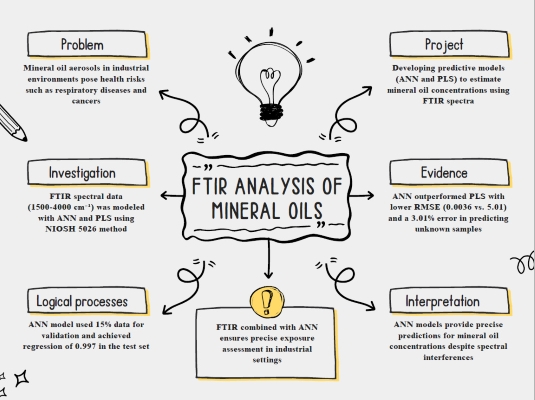
Introduction: Mineral oil, a key component of metalworking fluids, is a complex mixture that generates aerosols during industrial processes, posing significant respiratory health risks such as laryngeal cancer, asthma, and lung cancer. The NIOSH 5026 method uses Fourier Transform Infrared Spectroscopy (FTIR) to assess exposure to mineral oils. However, the diverse and complex compositions of mineral oils cause significant spectral interferences. Partial Least Squares (PLS) and Artificial Neural Networks (ANN) are advanced modeling methods used to address these interferences without manual intervention. This study aimed to predict mineral oil concentrations in an automotive industry using FTIR and modeling methods.
Material and Methods: FTIR spectral data (1500–4000 cm⁻¹) were recorded across 701 wave numbers and analyzed using PLS and ANN models. Input (matrix X) consisted of FTIR data, while output (matrix Y) represented mineral oil concentrations. Model performance was evaluated using Root Mean Square Error (RMSEp).
Results: The ANN model significantly outperformed the PLS model. The overall RMSEp for ANN was 0.0036, compared to 5.01 for PLS. ANN achieved a regression of 0.997 in the test set, with an average error percentage of 3.01%, while PLS yielded an error of 4.792. ANN modeling used 15% of data for validation and required fewer than 11 hidden layers to achieve optimal performance.
Conclusion: ANN modeling effectively predicted mineral oil concentrations despite spectral interferences, outperforming PLS in accuracy and error reduction. Both methods are viable for evaluating mineral oil exposure, but ANN offers superior predictive capabilities.
Material and Methods: FTIR spectral data (1500–4000 cm⁻¹) were recorded across 701 wave numbers and analyzed using PLS and ANN models. Input (matrix X) consisted of FTIR data, while output (matrix Y) represented mineral oil concentrations. Model performance was evaluated using Root Mean Square Error (RMSEp).
Results: The ANN model significantly outperformed the PLS model. The overall RMSEp for ANN was 0.0036, compared to 5.01 for PLS. ANN achieved a regression of 0.997 in the test set, with an average error percentage of 3.01%, while PLS yielded an error of 4.792. ANN modeling used 15% of data for validation and required fewer than 11 hidden layers to achieve optimal performance.
Conclusion: ANN modeling effectively predicted mineral oil concentrations despite spectral interferences, outperforming PLS in accuracy and error reduction. Both methods are viable for evaluating mineral oil exposure, but ANN offers superior predictive capabilities.
Keywords: Mineral oil, NIOSH 5026 method, Artificial neural network, Partial least square regression, Anticipation
Type of Study: Review |
Send email to the article author
| Rights and permissions | |
 |
This work is licensed under a Creative Commons Attribution-NonCommercial 4.0 International License. |
