

Volume 16, Issue 1 (3-2026)
J Health Saf Work 2026, 16(1): 80-98 |
Back to browse issues page



Download citation:
BibTeX | RIS | EndNote | Medlars | ProCite | Reference Manager | RefWorks
Send citation to:


BibTeX | RIS | EndNote | Medlars | ProCite | Reference Manager | RefWorks
Send citation to:
Biganeh J, Zakerian S A, Esmaeelpour Monazzam M R, Mohammadi S, Khosravi A, Shahtaheri S J. Effects of Noise and Aluminum Co-Exposure on Behavioral and Cognitive Indices and Biomarkers in a Wistar Rat Model. J Health Saf Work 2026; 16 (1) :80-98
URL: http://jhsw.tums.ac.ir/article-1-7306-en.html
URL: http://jhsw.tums.ac.ir/article-1-7306-en.html
Jamal Biganeh1 
 , Seyed Abolfazl Zakerian1 , Mohammad Reza Esmaeelpour Monazzam1 , Shima Mohammadi2 , Ahmad Khosravi3 , Seyed Jamaleddin Shahtaheri *4
, Seyed Abolfazl Zakerian1 , Mohammad Reza Esmaeelpour Monazzam1 , Shima Mohammadi2 , Ahmad Khosravi3 , Seyed Jamaleddin Shahtaheri *4
1- Department of Occupational Health Engineering, School of Public Health, Tehran University of Medical Sciences, Tehran, Iran
2- Department of Neuroscience, School of Medicine, Shahroud University of Medical Sciences, Shahroud, Iran
3- Department of Epidemiology, School of Public Health, Shahroud University of Medical Sciences, Shahroud, Iran
4- Department of Occupational Health Engineering, School of Public Health, Tehran University of Medical Sciences, Tehran, Iran. | Center for Water Quality Research (CWQR), Institute for Environmental Research (IER), Tehran University of Medical Sciences (TUMS), Tehran, Iran ,shahtaheri@tums.ac.ir
2- Department of Neuroscience, School of Medicine, Shahroud University of Medical Sciences, Shahroud, Iran
3- Department of Epidemiology, School of Public Health, Shahroud University of Medical Sciences, Shahroud, Iran
4- Department of Occupational Health Engineering, School of Public Health, Tehran University of Medical Sciences, Tehran, Iran. | Center for Water Quality Research (CWQR), Institute for Environmental Research (IER), Tehran University of Medical Sciences (TUMS), Tehran, Iran ,
Abstract: (141 Views)
Introduction: Combined exposures, such as noise and aluminum exposure, are present in many occupational workplaces. Nevertheless, the neurocognitive effects resulting from this co-exposure have been scarcely investigated. The present study aimed to determine the effects of noise and aluminum co‑exposure on behavioral and cognitive indices and biomarkers in a Wistar rat model.
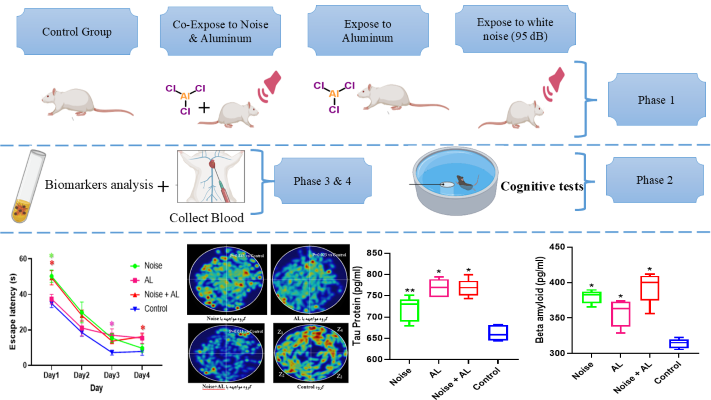
Material and Methods: This experimental study investigated 20 adult male Wistar rats over a period of 45 days, divided into four groups: 1. Control group (no exposure), 2. Noise exposure group (95 dB, 4 hours daily), 3. Aluminum chloride exposure group (10 mg/kg, daily intraperitoneal injection), and 4. Combined noise and aluminum exposure group (a combination of Group 2 and Group 3). Spatial memory performance was assessed using the Morris Water Maze test. The serum concentrations of total tau protein and beta-amyloid 42 were measured in blood samples using the ELISA method. Data were analyzed using SPSS software, version 27.
Results: Behavioral test results indicated that the control group spent the least time searching for the platform. Exposure to aluminum and the combination of noise + aluminum led to a significant decrease in cognitive performance. Furthermore, serum levels of tau protein and beta-amyloid were significantly increased in all exposed groups (p<0.01), and a strong positive correlation was observed between these two biomarkers (r=0.70, p<0.001).
Conclusion: Findings demonstrated concurrent noise and aluminum exposure can synergistically impact cognitive performance and neurodegenerative biomarkers. These alterations likely occur through shared mechanisms such as oxidative stress, neuroinflammation, and disruption of protein homeostasis. Increased tau and amyloid, coupled with memory decline, underscore this combined role in worsening neurodegeneration. These results suggest monitoring combined exposure and using blood biomarkers for early cognitive assessment.
Material and Methods: This experimental study investigated 20 adult male Wistar rats over a period of 45 days, divided into four groups: 1. Control group (no exposure), 2. Noise exposure group (95 dB, 4 hours daily), 3. Aluminum chloride exposure group (10 mg/kg, daily intraperitoneal injection), and 4. Combined noise and aluminum exposure group (a combination of Group 2 and Group 3). Spatial memory performance was assessed using the Morris Water Maze test. The serum concentrations of total tau protein and beta-amyloid 42 were measured in blood samples using the ELISA method. Data were analyzed using SPSS software, version 27.
Results: Behavioral test results indicated that the control group spent the least time searching for the platform. Exposure to aluminum and the combination of noise + aluminum led to a significant decrease in cognitive performance. Furthermore, serum levels of tau protein and beta-amyloid were significantly increased in all exposed groups (p<0.01), and a strong positive correlation was observed between these two biomarkers (r=0.70, p<0.001).
Conclusion: Findings demonstrated concurrent noise and aluminum exposure can synergistically impact cognitive performance and neurodegenerative biomarkers. These alterations likely occur through shared mechanisms such as oxidative stress, neuroinflammation, and disruption of protein homeostasis. Increased tau and amyloid, coupled with memory decline, underscore this combined role in worsening neurodegeneration. These results suggest monitoring combined exposure and using blood biomarkers for early cognitive assessment.
Type of Study: Review |
Send email to the article author
| Rights and permissions | |
 |
This work is licensed under a Creative Commons Attribution-NonCommercial 4.0 International License. |
