

Volume 16, Issue 1 (3-2026)
J Health Saf Work 2026, 16(1): 56-79 |
Back to browse issues page



Download citation:
BibTeX | RIS | EndNote | Medlars | ProCite | Reference Manager | RefWorks
Send citation to:


BibTeX | RIS | EndNote | Medlars | ProCite | Reference Manager | RefWorks
Send citation to:
Alinia Ahandani M, Raei M, Rouhollahei M, Valipour F, Derakhshanjazari M. A Novel Hybrid PFMEA-HFMEA Framework for Risk Assessment in Medical Imaging: Insights from Developing Healthcare Systems. J Health Saf Work 2026; 16 (1) :56-79
URL: http://jhsw.tums.ac.ir/article-1-7305-en.html
URL: http://jhsw.tums.ac.ir/article-1-7305-en.html
Mahdi Alinia Ahandani1 
 , Mehdi Raei2 , Mahboubeh Rouhollahei3 , Firouz Valipour2 , Milad Derakhshanjazari *4
, Mehdi Raei2 , Mahboubeh Rouhollahei3 , Firouz Valipour2 , Milad Derakhshanjazari *4
1- Student Research Committee, Baqiyatallah University of Medical Sciences, Tehran, Iran
2- Department of Occupational Health Engineering, Faculty of Health, Baqiyatallah University of Medical Sciences, Tehran, Iran
3- Chemical Injuries Research Center, Systems Biology and Poisonings Institute, Baqiyatallah University of Medical Sciences, Tehran, Iran
4- Department of Occupational Health Engineering, Faculty of Health, Baqiyatallah University of Medical Sciences, Tehran, Iran ,derakhshan_milad@yahoo.com
2- Department of Occupational Health Engineering, Faculty of Health, Baqiyatallah University of Medical Sciences, Tehran, Iran
3- Chemical Injuries Research Center, Systems Biology and Poisonings Institute, Baqiyatallah University of Medical Sciences, Tehran, Iran
4- Department of Occupational Health Engineering, Faculty of Health, Baqiyatallah University of Medical Sciences, Tehran, Iran ,
Abstract: (96 Views)
Introduction: Medical imaging modalities such as MRI and CT scans are indispensable for accurate diagnosis, yet they pose substantial operational and patient safety risks—particularly in resource-limited healthcare systems.
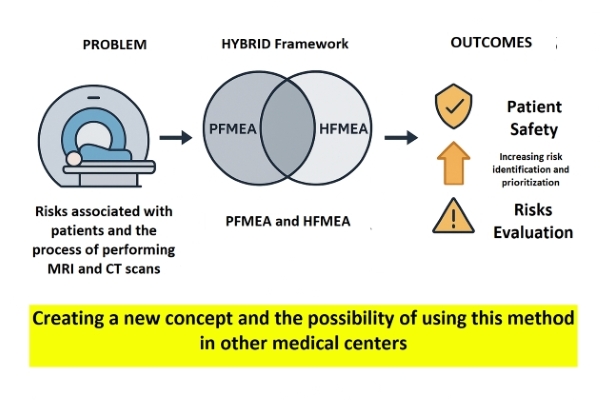
Material and Methods: This applied methodological study, conducted from July 2024 to April 2025, used a four-phase methodology: scoping, data collection, framework development, and risk analysis. Data were gathered through FGDs involving radiologists, technicians and HSE experts and also with semi-structured interviews and process mapping, which identified 125 failure modes across nine workflow stages. PFMEA assessed operational risks, whereas HFMEA focused on patient-centric hazards. A composite risk indicator that comprising 40% PFMEA RPN and 60% HFMEA hazard score, prioritized risks. Statistical analyses, including Shapiro-Wilk, Spearman’s correlation and Kruskal-Wallis tests, were used to evaluate risk distributions and inter-stage variability.
Results: The framework identified critical risks, such as insufficient operator training and staff fatigue, with post-process management and image reconstruction as high-risk phases. MRI and CT units showed distinct yet overlapping risk profiles that show significant inter-stage variability (p<0.001). The hybrid model integrated operational and clinical perspectives, which outperformed standalone FMEA methods.
Conclusion: This hybrid PFMEA-HFMEA framework offers a scalable and context-sensitive approach to enhance patient safety with operational resilience in medical imaging. Further studies should authenticate the framework in different settings and investigate long-term mitigation strategies to enhance radiology risk management.
Material and Methods: This applied methodological study, conducted from July 2024 to April 2025, used a four-phase methodology: scoping, data collection, framework development, and risk analysis. Data were gathered through FGDs involving radiologists, technicians and HSE experts and also with semi-structured interviews and process mapping, which identified 125 failure modes across nine workflow stages. PFMEA assessed operational risks, whereas HFMEA focused on patient-centric hazards. A composite risk indicator that comprising 40% PFMEA RPN and 60% HFMEA hazard score, prioritized risks. Statistical analyses, including Shapiro-Wilk, Spearman’s correlation and Kruskal-Wallis tests, were used to evaluate risk distributions and inter-stage variability.
Results: The framework identified critical risks, such as insufficient operator training and staff fatigue, with post-process management and image reconstruction as high-risk phases. MRI and CT units showed distinct yet overlapping risk profiles that show significant inter-stage variability (p<0.001). The hybrid model integrated operational and clinical perspectives, which outperformed standalone FMEA methods.
Conclusion: This hybrid PFMEA-HFMEA framework offers a scalable and context-sensitive approach to enhance patient safety with operational resilience in medical imaging. Further studies should authenticate the framework in different settings and investigate long-term mitigation strategies to enhance radiology risk management.
Type of Study: Review |
Send email to the article author
| Rights and permissions | |
 |
This work is licensed under a Creative Commons Attribution-NonCommercial 4.0 International License. |
